Posts mit dem Label underwear werden angezeigt. Alle Posts anzeigen

Samstag, 20. Dezember 2014

A study in dusky pink

I made a corset. It has several issues, but hey. I made a corset! :)
When I started it (ahem, that was maybe three years ago), proper research wasn't that much of a priority yet. So for some reason I decided to use totally unsuitable fabric as interlining. I guess this is the main reason for the crazy horizontal creasing, another being the pattern which I probably should have modified more. I used the Laughing Moon Dore pattern.
The corset is made of cotton satin for the outer layer, fine linen for the lining, and some weirdly thick but too soft cotton for the interlining.
I already wore the corset for a full day. Unfortunately it doesn't only look imperfect, it's also chafing my waist after a few hours. :( It's a pity because initially it feels very comfortable.

Anyway. I made a corset. :)
I also took pictures:


The front. Don't you think it looks a bit like it was made for really droopy boobs? I have no idea why the pattern does that, and why I didn't notice it when making the muslin. It's extra funny because the upper edge is a bit too tight around the bust. 
On plus side, I found a perfectly matching lace ribbon in my stash. 


The back. I didn't have proper corset lace, so I put some white ribbon from stash into black tea dye. Strangely enough, it didn't come out yellow-ish like you would expect from tea dye, but light pink. Another perfect colour match.


Me wearing it. Really brings out the horizontal creases. (I took this picture before I added the lace ribbon).
Of course there's also the much feared problem of gaping above and below the busk.

I'm pretty sure the chafing in the waist results from the unsuitable interlining fabric, which should be a lot stiffer.
I still love the colour of the outer fabric and for a short time it is really comfortable to wear. I'll probably not use the pattern again, but instead try the Truly Victorian corset pattern for my next one. As always, I learned a lot while making this corset, and I'm looking forward to make the next one!


Montag, 5. Mai 2014

1920s slip

Before I started to work on the robe de style, I decided to warm up with the slip that I planned to wear underneath. A slip is a necessary undergarment that protects the skin from the material of the outer dress, e.g. scratchy wool, and also protects the outer garment from sweat or skin oils. Furthermore it smoothes the line and helps the dress to hang correctly. Plus, it's the perfect excuse to use all that whimsical lace. ;)

1920's Cream Lace Chemise with Hand Embroidery from wearitagainsamvintage.com

French silk/lace slip, 1920s. Can't find the original source, sorry :(

A beautiful vintage slip from wildrosevintage.blogspot.com

A more conservative slip from the Metropolitan Museum

A black 1920s silk slip from the Metropolitan Museum


So I went trough my stash, actually in hope of finding some suitable silk, but then I came across a rather firm but smooth black and completely opaque rayon which I deemed perfect for the task. It has little spades woven into it and feels wonderful on the skin. I guess it's the stuff that is normally used for the backs of modern waistcoats.

front view

I used this pattern (or rather, these instructions) from realhistoricalpatterns.tumblr.com (which is a great blog by the way, thank you so much whoever you are!)

The pattern/instructions worked really well. The fact that my slip has a seam at the waist which isn't supposed to be there is just because I'm an idiot who can't accept that cutting fabric after midnight is not a good idea. I had no more fabric to cut it again, but then it's not that terrible a mistake. The slip is still doing what it's supposed to, and nobody is going to see it anyway.

side view
I admit, the lace I sewed on the hem looks a bit forced. I could probably have used it in a more graceful manner, but I didn't have an awful lot of time to finish the slip. Moreover, I was angry at the lace and wanted it to be gone quickly. I ordered it as stretchy lace on ebay for a totally different project and received this one, which is about as stretchy as hemp rope and for which I absolutely didn't have any other use, so it ended up on the slip.

back view

All in all, I am very happy with this garment. Stupid mistakes aside, it was easy to sew and I made the right fabric choice - smooth against the skin and against the dress fabric.


Mittwoch, 23. Oktober 2013

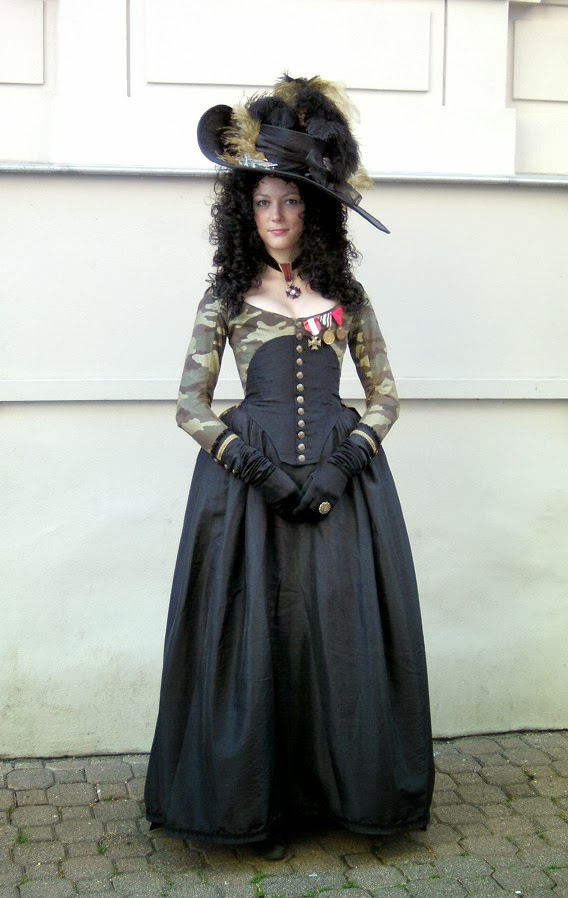
Costume recap - The Camococo

Back in 2011, a good friend had the awesome idea to make 18th century dresses out of camouflage fabric (yes, I have strange friends). As I am genetically incapable of resisting a crazy idea, of course I had to participate. Moreover, I wanted to try 18th century clothing for some time, and this was the perfect opportunity. If I got it wrong, at least I wouldn't get it wrong using expensive silk and investing hours of handstitching, right?
I quickly decided that it should be a zone front gown, and that I would use classic olive green camo fabric, combined with black poly taffeta. A huge hat should complete the ensemble.

But first - underthings! I decided to try the Diderot stays pattern from Nora Waughs "Corsets and Crinolines", and it worked like a charm.

Boobies alarm! It's incredible what these stays do to your décolleté...

Looks good, feels good. Success!
They are actually comfortable! I know, fabric is wrong, no visible boning channels wrong, metal eyelets wrong, machine stitching wrong, synthetic ribbon wrong.... but hey, the pattern is authentic! And it fits, which means I can use better materials and invest more work next time without risking that it doesn't fit after weeks of handstitching.

Now for the dress: I used an Anglaise pattern from Janet Arnolds "Patterns of Fashion" and altered the front so it would have the "zone gown" look. I decided that I wanted long sleeves, so I used a long sleeve pattern I found in Nora Waughs "The Cut of Women's clothes". For the skirt I used the tutorial at La Couturiére Parisienne and adapted it so it would fit over a bum pad. I also made a cotton petticoat with ruffles in the back to wear underneath, but I don't think the ruffles add much to the effect.

Anyway, pictures!!


The Camococo dress, complete with hair, hat, and nonsense medals I got from ebay


I'm actually not satisfied with the bum pad. It's too small.

The above two pictures were taken in Leipzig at the Wave Gotik Treffen, where I wore the dress for the first time. The hair is not at all my own hair, but an insanely curly wig, which adds a lot to the whole ensemble. 

I also made the hat from scratch - it has a buckram frame covered with black silk (yes, real silk :D ) and is decorated with organza (not silk), a metal buckle, LOTS of feathers, and a miniature aircraft carrier (which unfortunately isn't really visible on the pictures).

This year, I decided to wear the dress again to Barockfest at Schloss Hof, which is more of a carnival than a serious costume event, so I thought the dress would be appropriate. I also wore it because I don't have another 18th century dress yet, but wanted to go to Schloss Hof. However, it turned out to be the right decision, because I totally unexpected scored 3rd place at the costume contest (which I didn't even know about beforehand)! :D

I restyled the wig to look more like a "Hedgehog" which didn't work perfectly, but it's still okay with the hat ;)

Relaxing in the beautiful gardens of Schloss Hof

With my friends Eleanor Vivian (middle) and BlackAngel (right), who were both also nominated at the costume contest! Congratulations to us all! :)

Donnerstag, 17. Oktober 2013

Costume recap - The Escher Naise

Okay, I have nothing new to show yet, so I'll just start with some of my old projects before it gets boring here.

One of my all time favourite gowns is my victorian polonaise (dubbed "Escher Naise" by my friend Mme. Eleanor Vivian, because the pattern looks a bit like it formed in the head of M.C. Escher).
I made it for the WGT 2010 (gothic festival in Leipzig, Germany), so I didn't bother to use only historically accurate fabric. Besides, it was only my second try at victorian clothing, and I don't want to use expensive silk or wool when I'm not yet sure what I'm doing.So the fabric is some mixed fiber (I think it was actually intended for furniture), the edges are bound with velvet and the sleeves are decorated with two layers of fine black lace. The front closes with hooks and eyes. The skirt is made from ordinary black cotton and has a broad ruffle at the hem, decorated with velvet ribbon.
I used the well-known Truly Victorian pattern, but altered the sleeves so they would look a bit like 18th century sleeves. The pattern went together very well, but I'll probably not use it again, at least not as it is - you see it too often these days, and somehow it's funny meeting people at events that basically wear the same dress as you do. (Yes I know, different fabric and styling and all, but it's just weird when you can tell exactly which pattern a dress was made of from 100 metres away.)

 Anyway, I'm very pleased with how it came out. It fits like a glove, and I'm especially proud of the exact pattern matching in the front. 

Enough of the talking, on to the pictures! 


With lovely Mme. Eleanor Vivian on the left - all the stripes on her dress match exactly at the seams!

Here you can see the pattern better. Picture and editing by Alexander Löbel (thanks again!!).

Again with Eleanor Vivian - picture and editing by the wonderful Alwa Petroni / Graubild


The dress also passed the picnic test! :D (I actually don't have weird super-long legs - I just took off my boots *lol* )

This is how it looks on my dress form at home. The light is terrible and I couldn't close it all the way down, but at least you can see the whole dress.

The drapery from the side...

... and from the back.

And this is the shellfish I wore underneath.

"If you try to park your beer glass on my behind, I'll kill you!"